
Simon L Jones
From Cowbridge to California: The Life of a Welsh Immigrant, Senator, and Entrepreneur
Wales, 1813 — A Cowbridge Beginning
Simon L Jones was born in 1813 in Cowbridge, Wales.
Texas, 1839 — Ranger, Rancher, Senator
Jones emigrated to Galveston, Texas in 1839. During his time in Texas, he worked as a Texas Ranger, cattleman, businessman, and politician who served as a state senator. He married Margaret Everett, the daughter of a judge, on April 23, 1847 in Mobile, Alabama. The 1850 US Census lists the couple living in Texas with their first son, Lloyd, then 6 months old.
California, 1852 — Chasing Gold to San Francisco
His move to California was later described this way: “shortly after the discovery of gold in California he determined to join the brave army of volunteers in quest of fortune and a home … and in 1852 came to San Francisco.” At the time, Jones was in his late 30s — relatively old compared to most other fortune seekers headed to California.
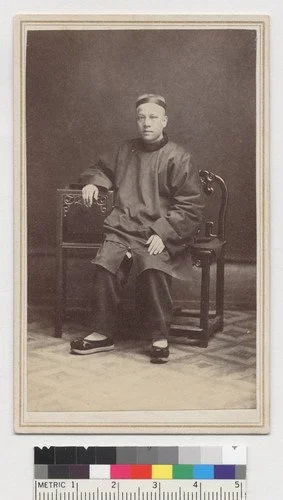
Jones joined his friend Cobb in an auction house that sold tea and other commodities, headquartered in San Francisco. There he met, and eventually partnered with, a young Chinese merchant named Fung Tang, who established the Hong Kong branch of the S.L. Jones Co. Such relationships were unusual for the era, given the widespread anti-Chinese sentiment of the post-Civil War years.
The 1860 US Census lists the family living in San Francisco with Lloyd, aged 9, and their younger children, Everett and Helen, ages 7 and 3 respectively.
By 1870, Jones was serving as treasurer of The Cambrian Mutual Aid Society of San Francisco. The society was incorporated on September 3, 1869, and was active throughout the 1870s. It was established to provide support to Welsh immigrants in California, particularly members facing sickness or hardship, and met at Cambrian Hall, 1133 Market Street, San Francisco.
Hazelwood Farm, 1872 — Building a Legacy
Jones purchased 1,500 acres of timberland in 1872 and called it Hazelwood Farm. He developed the property agriculturally, planting many vineyards, crops, and orchard trees as well as raising livestock. An inventive developer of his land's resources, he discovered water springs, oil, natural gas, and sulphur springs on the property.
Needing a way to store and preserve the crops harvested from his farm, Jones built a small rectangular building with a wood gable roof, a central ventilation cupola, a door, and two small windows, sited at the bottom of a hill near the creek. On July 25, 1874, the Redwood City Press Democrat reported that "S.L. Jones is building a stone dairyhouse at his place near Searsville, 19' x 21' with 10" walls and 10' in the clear."
Set in a cool location and built with thick walls insulated with straw and sawdust, the structure maintained a naturally cool interior, allowing produce, dairy products, and meat to stay preserved for long periods. This method of food preservation was common before the advent of electricity and refrigeration. Of all the buildings Jones constructed, the "dairy house" is the only one still standing today.
By the 1870s, S.L. Jones & Co. had become a leading exporter of goods to China, shipping over US $700,000 worth of Californian wheat to Hong Kong and building an annual China trade volume of more than $1 million. Jones was also the West Coast's largest tea trader—and even turned his Hazelwood Farm grapes into another export line, drying them into raisins for the China trade, reportedly shipping 14,000 lbs of them in 1886.
His working relationship with Fung Tang also allowed Jones to bring over Chinese laborers and craftsmen, who built the network of roads, trails and “dry stack walls” throughout the property. Built from rocks fitted together without mortar, these walls have withstood earthquakes and decades of weathering without deteriorating. Today known as The Chinese Walls, they are part of the Folger Stable Historic District on the National Register of Historic Places, in what is now Wunderlich Park — and were honored with a plaque dedication in 2008. Jones testified before Congress against the Chinese Exclusion Act of 1882, despite the risk this unpopular position posed to his business.
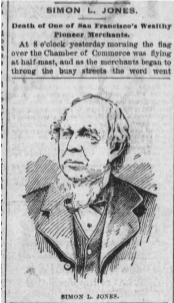
Jones was a prominent businessman and one of the first members of the San Francisco Chamber of Commerce. When he died in 1889, most of the businesses in San Francisco’s Chinatown closed for the day in mourning, and the business community passed numerous resolutions and tributes in his honor.
NOT SURE IF WE’RE ALLOWED TO POST THESE PHOTOS WITHOUT PERMISSION!!!
Hazelwood Farm, 1890 — Son Everett Takes Over
After Simon L Jones died, the ranch passed to his son Everett, who attempted to operate the site as a bed & breakfast. A 1901 publication advertised Hazelwood Farm as “an hour’s drive from the Redwood Depot, pleasantly located in the foothills with a fine climate,” noting that stage fare was 50 cents and board ran $8-10 per week. The arrangement apparently wasn’t profitable enough to sustain because by 1902 the property had sold, prompting this notice: “This village has added another new resident to its growing population in the person of J.A. Folger II of San Francisco, who has purchased the Jones place, known to many through its sulphur springs, mountain drives, and other things too numerous to mention. Mr. Folger intends building a fine residence on his new domain.”